

An excerpt from the booklet essay by Peter Hames
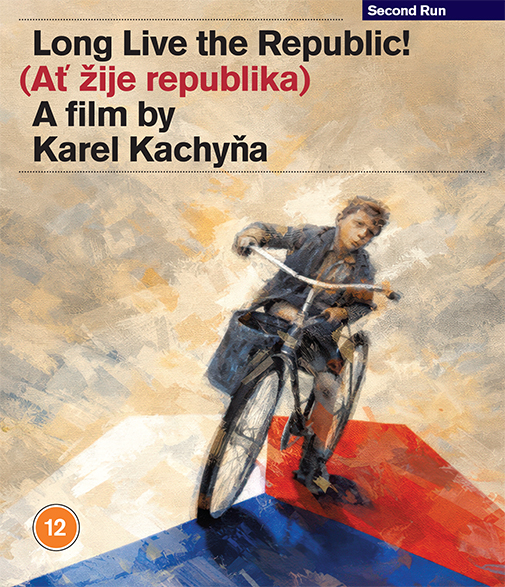
In Long Live the Republic!, Jan Procházka and Karel Kachyňa made a partly autobiographical work that was supposed to celebrate the liberation from German occupation. But it is a far cry from the ideological simplifications normally associated with the genre. It is presented as the subjective experience of 12-year-old Olda (Oldřich, nicknamed Pinďa or ‘midget’) and, as such, the period of the liberation is portrayed without an interpretative historical framework – the Germans are simply leaving and the Russians are arriving. Recalling his own experiences watching the liberation from the roof of his house, Prochazka wrote: “Both armies had been bled white, they were staggering, resembling each other in their desperate exhaustion”.
It’s highly inventive in its use of cinematography and editing, with the present, the past, and dream merging in a feverish and unremitting flow, providing a child’s eye view of the world as something that is frequently oppressive and dangerous. Beaten regularly by his father, Olda sees adults primarily as threats. Russians and Germans appear in isolated incidents, with overall developments presented in an oblique and half understood manner.
Underneath this reality and its complex superstructure is a discernible set of experiences. Olda’s domestic life is repressive, but he roams freely through the countryside, where he not only confronts the aggressive village boys, but also Cyril, who invites him to see puppies. Three Germans steal his horse and cart and he pursues them, encounters Russians, and continues to search for his horse, Julina.
There is, of course the triumphal entry of the Soviet troops at the end. But following the slogans ‘Long Live the Republic!’, ‘Long Live the Soviet Union!’, and ‘Long Live Stalin!’, the villagers stone Cyril, the only man who had befriended Olda, accusing him of being an ‘informer’. As a result, Cyril commits suicide. Olda, in turn, is beaten by the other boys and urinated on. These negative associations with what was normally a subject of eulogy were clearly deliberate and polemical – but they are less explicitly ‘subversive’ than suggestive of the reality of contradiction, that experience and history escape any narrow political explanation.
While the violence of war is largely off screen, that of everyday life is not. Apart from his father’s beatings, Olda is also pursued by the village children and victimised. His dreams of freedom sometimes take conventional forms (being transported into the air by kite or by Julina) and his love of horses, dogs and puppies could feature in many a more commercial movie. But this is counterbalanced by a dark side. A horse has to be shot, a dog is buried, a squirrel subjected to violent pursuit, and Olda shoots a pigeon with his catapult. The film is believable as an authentic portrait of the liberation, and its grim faced but believable community may be closer to reality than the community of friends we find at the beginning of Vojtěch Jasný’s All My Good Countrymen (Všichní dobří rodáci, 1968).
Peter Hames' complete essay, from which this excerpt is taken, appears in the booklet which accompanies the release.

Blu-ray Reviews
Sight and Sound
DVD Beaver
London
Grip
Close-Up Film
Blueprint Review
Cinemas Online
The Geek Show
Cine Outsider
DVD Compare
The Arts Desk
Film Reviews
Eye for Film
Time Out
Centre for Contemporary Arts
Film at Lincoln Center
Connections
i. Peter Hames on Long live the Republic! and Kachyňa
ii. Karel Kachyňa obituary at The Guardian
iii. Karel Kachyňa and The Holocaust: More Than Films for Children
iv. Ivana Košuličová on Kachyňa
v.
1945: Czechoslovakia at a Crossroads

Czechoslovakia, 1965
Length: 133 minutes
Sound:
2.0 Dual Mono
Black and white
Original aspect ratio: 2.39:1
Language: Czech
Subtitles: English
Blu-ray: BD50
1080 / 24fps
Region ABC (Region Free)
Blu-Ray: £19.99
Release Date:
16 March 2026
